

Progressive delivered a strong performance in personal lines auto in 2025, posting a combined ratio of 87.5 despite a softening market and several years of industrywide rate increases aimed at restoring profitability. The company has established itself as a market leader in personal auto insurance, supported by disciplined underwriting practices and highly sophisticated pricing capabilities.
However, recent customer behavior data reveals a more complex picture beneath that headline performance.
In the most recent JD Power Quarterly Insurance Shopping LIST Report, which tracks customer shopping activity, loyalty, and attrition across the nation’s leading personal lines insurers, Progressive stands out on two seemingly contradictory fronts. Progressive recorded the strongest growth in auto policies during 2025, with new business volumes outpacing both State Farm and GEICO. At the same time, Progressive also experienced the highest rate of customer churn, with more auto policyholders leaving the company than any other major carrier. The report further shows that shopping activity among Progressive customers increased in the fourth quarter of 2025, likely reflecting heightened competitive pressures as market conditions evolved.
Leading both customer inflows and outflows raises an important question: What does it mean when an insurer excels at acquisition while simultaneously experiencing high attrition?
The answer is not straightforward. For Progressive, these dynamics point to a nuanced customer mix and a highly active portfolio shaped by sophisticated pricing, rapid market responsiveness, and changing consumer behavior. Understanding who is being acquired, who is leaving, and where those customers are going is critical to interpreting what these trends signal about long‑term growth, retention, and profitability.
This case study begins to unpack those dynamics, using JD Power data to examine the underlying drivers of Progressive’s growth and churn—and what they reveal about the broader personal auto insurance marketplace.
Progressive Defector Profile
The data shows that Progressive experienced higher‑than‑average attrition among customers with less favorable credit histories in 2025, particularly those categorized as having fair or poor credit. In addition, the company saw elevated churn among “Dianes”—customers who have both an auto and renters insurance policy—with this group accounting for 53% of defections.
Notably, Progressive largely offset these losses through acquisition. New “Dianes” represented 55% of new policy growth during the same period, suggesting that while exposure within this segment remains fluid, the company continues to successfully replace departing customers with new bundled policyholders. This pattern points to an actively managed book rather than a static customer base.
2025 Progressive Defector Break Down by Demographic
Customer Segment Definitions
- Sam: Has an auto policy but does not rent or own his home, he lives with relatives or has some other living situation
- Diane: Has an auto policy and rents her home
- The Wrights: Own their home but don’t bundle their home and auto policy
- The Robinsons: Own their home and bundle their home and auto policy together
A notable proportion of Progressive’s defectors were from Texas, Florida, and California, due in part to increased competition paired with too high premiums and premium hikes over the years in those markets.
Among Progressive’s Florida defectors, an above average number cited either their rates were too high or rate recently increased (50% in Florida vs. 39% nationally for Progressive). Notably, GEICO is capturing a significant proportion of Progressive’s Florida defectors (47%).
Progressive New Customer Profile
Progressive attracted a meaningful share of “Diane” customers—those holding both auto and renters insurance—during 2025, making this segment a key driver of new business growth. While the company has articulated a strategic objective to expand its base of “Robinsons” (bundled auto and homeowners customers), realized growth in that segment lagged overall industry trends. Robinsons accounted for 13% of Progressive’s new customer inflow in 2025, compared with an industry average of 23%.
According to the company’s financial disclosures, this divergence reflects deliberate profitability-focused initiatives rather than a lack of demand. Progressive implemented measures to improve underwriting performance, including tighter controls on new homeowner policy applications. While these actions supported portfolio profitability, they also curtailed new business volume within the homeowners segment, contributing to slower Robinson acquisition relative to peers.
Taken together, the inflow data suggests that Progressive’s growth in 2025 was shaped less by broad-based expansion and more by targeted customer acquisition aligned with profitability objectives.
Progressive New Customer Break Down by Demographic
Customer Segment Definitions
- Sam: Has an auto policy but does not rent or own his home, he lives with relatives or has some other living situation
- Diane: Has an auto policy and rents her home
- The Wrights: Own their home but don’t bundle their home and auto policy
- The Robinsons: Own their home and bundle their home and auto
Texas and Florida also became states in which Progressive gained a notable number of new customers in 2025. Progressive became more price competitive in Florida after filing for rate reductions so it’s not surprising that 35% of Progressive’s new customers in Florida indicated they were shopping due to their rate being too high with their former carrier (versus 28% nationwide for Progressive).
Progressive’s Inflow/Outflow
The competitive landscape within acquiring and losing customers shows that Progressive lost more defectors to GEICO and State Farm than it gained from each of these companies. The General received an outsized number of Progressive’s defectors overall, and an even greater number of Progressive defectors in the poor or fair credit history tiers.
The LIST data shows Progressive acquired slightly more customers from USAA and Liberty Mutual than it lost to these brands.
Progressive’s Inflow/Outflow: Bundlers
To understand how the inflow and outflow trends align with Progressive’s strategy to acquire more Robinsons, we examined customers who bundle their auto and home policies across the competitive landscape. It’s notable to see the inflow and outflow patterns shift compared to the overall population.
State Farm is Progressive’s greatest competitor within this segment, capturing 34% of all Progressive’s defectors who are Bundlers (vs. 24% overall) in 2025. Meanwhile, Progressive gained in this segment at an even rate across competitors State Farm (21%) and GEICO (20%).
Aligning Trends with Progressive’s Strategy
The trends observed in the Insurance Shopping LIST data closely reflect Progressive’s stated personal auto strategy, as outlined in the company’s public financial disclosures. While Progressive has emphasized expanding its base of bundled auto and homeowners customers—referred to as “Robinsons”—the data suggests that growth in this segment has been pursued selectively rather than aggressively.
In fact, measures implemented to improve profitability, including restrictions on new homeowner policy applications, appear to have constrained new business growth among Robinsons. In 2025, LIST data shows that the broader industry gained nearly twice as many Robinson customers as Progressive, underscoring the carrier’s willingness to sacrifice volume in favor of underwriting discipline. Despite this, Progressive’s overall customer profile remained stable. The composition of new customers closely mirrored that of defectors, even as the company led the market in both customer acquisition and attrition. This stability indicates that Progressive effectively preserved its intended customer mix amid elevated shopping activity.
Taken together, these dynamics point to a measured approach to portfolio management. Progressive has leveraged pricing sophistication and disciplined underwriting to navigate a highly competitive environment, prioritizing sustainable, profitable growth over rapid expansion.
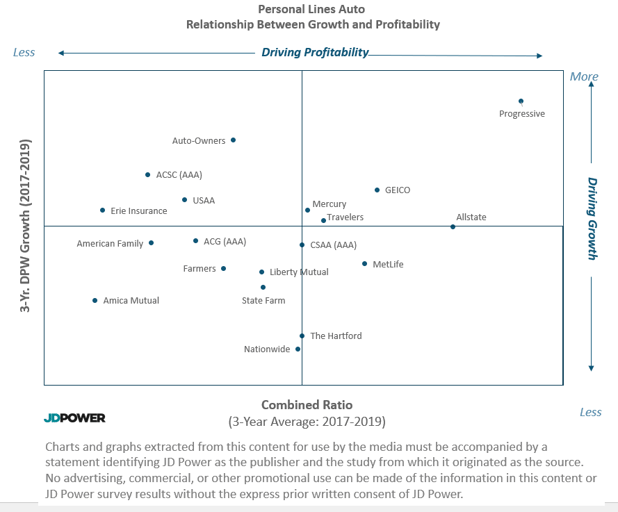
This operating strategy has shown to be successful historically. A prior analysis from the JD Power U.S. Insurance Shopping Study examining premium growth against profitability found that Progressive consistently outperformed peers by achieving strong direct written premium growth while maintaining combined ratios below industry averages. The carrier’s ability to grow profitably, rather than simply grow quickly, has been a defining characteristic of its market performance.
Looking ahead, these strategies suggest that Progressive is well positioned to sustain favorable market share and profitability into 2026 and beyond. A more current analysis of these trends, along with broader insights into customer shopping behavior and loyalty, will be available in the forthcoming JD Power U.S. Insurance Shopping Study, scheduled for release in April.
Find out More
The JD Power Insurance Shopping LIST provides a unique, daily view of insurance shopping and loyalty behavior across auto, homeowners, and renters lines at both the national and state levels. The data tracks competitive movement among leading carriers, showing who consumers are, where they are shopping, which brands they consider, how households are composed, and what other insurance or ancillary products those households hold.
The JD Power U.S. Insurance Shopping Study offers a deeper examination of shopping and switching behavior by analyzing how shoppers enter the market and the key factors that influence their decision-making. The study applies an acquisition‑funnel framework to benchmark insurer performance at each stage of the customer journey—from awareness and consideration to quoting and policy purchase—providing insight into where carriers gain or lose momentum in converting shoppers into new customers.
Share this

The Impact of Inflation on Insurance Shopping

Insurance Shopping One Year Later

No Comments Yet
Let us know what you think